Diffusion Model-based Precipitation Downscaling
Overview
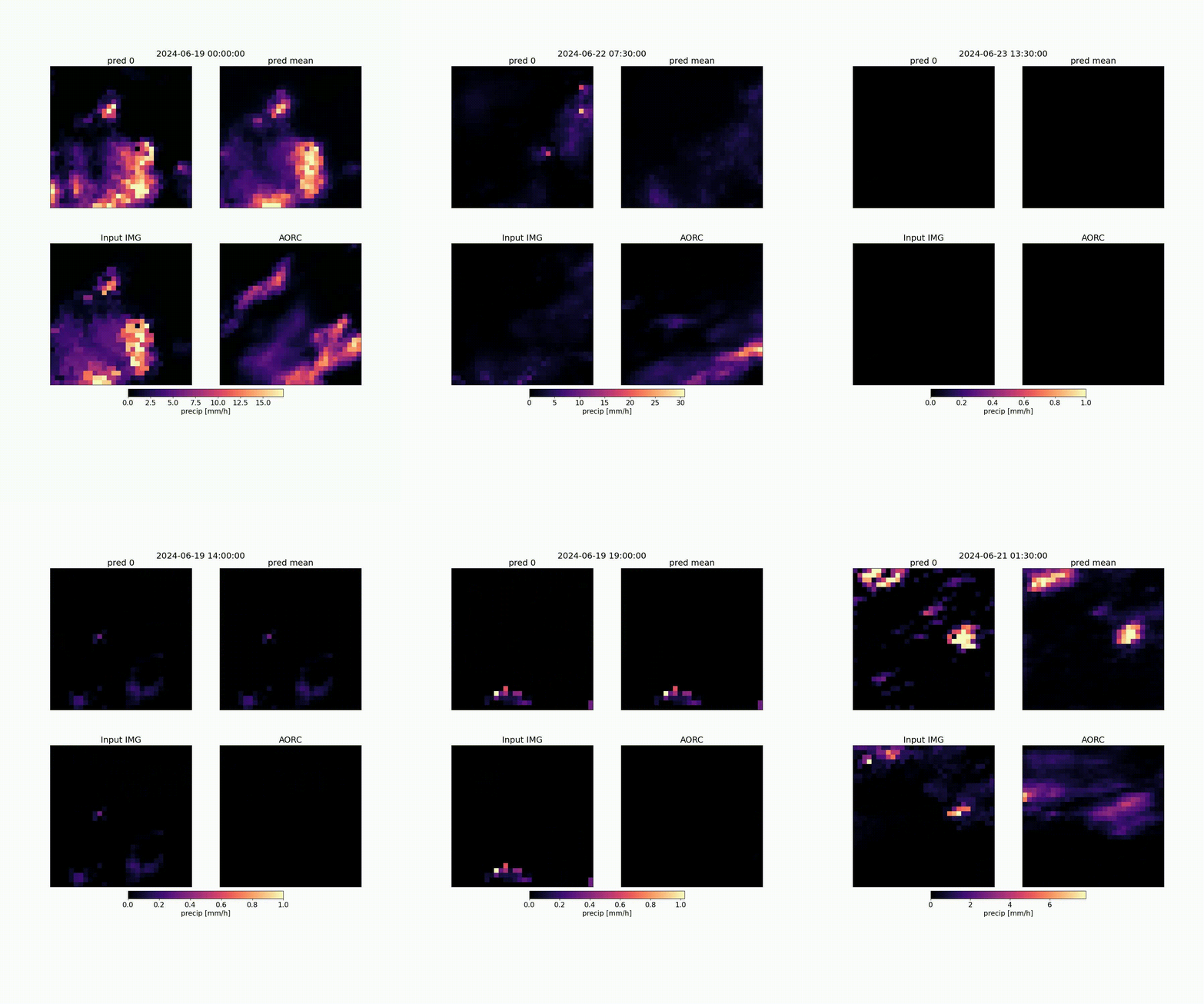
Deep learning models have been explored for precipitation error modeling, typically relying on ground-based radar data for training. In this study, we leverage diffusion models for their inherent probabilistic generative ability to create a satellite-based ensemble precipitation dataset. Specifically, DPR observations are used as a space-based precipitation ground truth to quantify uncertainties in IMERG estimates. The residual-based diffusion model architecture from Mardani et al (2025) is adopted. Our approach first applies a nowcasting technique to address the four-hour latency gap in IMERG Early, followed by bias correction and spatial downscaling to improve both accuracy and resolution. Atmospheric variables from GEOS-FP and DEM are used as auxiliary conditional variables in the diffusion model. This method generates a thirty-member precipitation ensemble with a 0.05°, 30-minute spatiotemporal resolution, suitable for real-time applications. Preliminary results from a multi-day heavy rainfall event in Iowa (June 2024) show notable improvements from our diffusion model. Ongoing work includes integrating flash flood modeling to further assess the precipitation ensembles’ applicability.